
Commodities
In this lesson we will examine:
- The definition of a commodity
- How fundamentals move commodity prices
- Seasonality and other factors in the price of commodities
Commodities are a unique sector within financial markets. As we have seen in a previous lesson, commodities are highly sensitive to the dynamics of supply and demand. Commodity prices are also affected by economic factors and consumer habits, and prices can fluctuate as a result of changes to these factors.
Commodity Definition
A commodity is usually a natural resource that can be processed and sold. These include raw agricultural products, metals, energies, minerals, and more.
The sale and purchase of commodities is usually carried out through standardized futures contracts on different exchanges.
A futures contract is a type of derivative instrument, or financial contract, in which two parties agree to transact a set of financial instruments or physical commodities for future delivery at a particular price. If you buy a futures contract, you are basically agreeing to buy something that a seller has not yet produced for a set price.
The prices of these futures contracts form the basis for many commodity CFDs.
Some of the biggest futures exchanges in the world for commodity trading now follow.
CME Group
The Chicago Mercantile Exchange (CME) is a global commodity and derivatives marketplace based in Chicago.
The Chicago Board of Trade (CBOT) merged with the Chicago Mercantile Exchange (CME) in 2007 to form the CME Group.
In 2008, shareholders approved a merger with the New York Mercantile Exchange (NYMEX), Commodity Exchange, Inc (COMEX). CME, CBOT, NYMEX, and COMEX are now markets that are all owned by the CME Group.
CME Group operates four major exchanges, each offering futures and options contracts across a range of asset classes.
CME offers products including livestock, dairy and lumber futures, while CBOT is particularly associated with agricultural commodities such as corn, wheat and soybeans.
NYMEX is a major marketplace for energy products, including crude oil and natural gas, as well as certain metals.
COMEX specializes in metals, including gold, silver and copper.
These examples are illustrative rather than exhaustive, as exchanges may introduce, modify or discontinue products over time.
Intercontinental Exchange

Intercontinental Exchange (ICE) is a global operator of financial and commodity exchanges, clearing houses and market infrastructure.
Its exchanges include ICE Futures Europe, ICE Futures U.S. and other international marketplaces. ICE offers futures and options contracts covering commodities such as crude oil, natural gas, electricity, coffee, cocoa, cotton and sugar, alongside financial products including interest-rate and equity derivatives.
London Metal Exchange

The London Metal Exchange (LME) is a futures exchange with the world’s largest market in options and futures contracts on base and other metals.
Despite being a global leader in metals, the LME does not deal in gold or silver – these are traded on the London Bullion Market, by the members of the London Bullion Market Association
The London Metal Exchange (LME), part of HKEX Group, is a major international marketplace for industrial metals. Its products include futures and options contracts covering metals such as aluminium, copper, lead, nickel, tin and zinc, alongside other industrial metal products.
Commodity Futures
A commodity futures contract is an agreement to buy or sell a predetermined amount of a commodity at a specific price on a specific date in the future. Commodity futures can be used to hedge or protect an investment position or to bet on the directional move of the underlying asset.
Many investors confuse futures contracts with options contracts. With futures contracts, the holder has an obligation to act – either to deliver the physical product or take delivery of it.
Some commodity futures contracts are physically settled, meaning that positions held into the delivery period may create an obligation to deliver or accept the underlying commodity.
Retail brokers commonly require traders to close physically deliverable futures positions before the relevant delivery deadlines and may automatically liquidate positions that remain open. However, these procedures vary between brokers and contracts, and traders should never assume that physical delivery obligations or associated costs are automatically eliminated.
Commodity CFDs differ from physically settled futures because they provide exposure to price movements without requiring delivery of the underlying commodity.
Fortunately, when trading CFD commodities, there is no obligation to act.
Commodity Market Participants
We can divide participants in commodity markets into two groups: real participants (producers and buyers) and speculators.
The first group produce commodities for end-buyers that use commodity futures contracts for the hedging purposes for which they were originally intended.
Commodity futures used by companies give a hedge to the risk of adverse price movements. The goal of hedging is to prevent losses from potentially unfavorable price changes rather than to speculate.
Companies that use hedging are typically producers of the commodity or the buyers of that commodity. Farmers, oil producers, livestock breeders, manufacturers, airlines and others may engage in commodity futures markets to hedge against price moves that might negatively impact their business.
The second type of commodities trader is the speculator. These are traders who trade in the commodities markets for the sole aim of profiting from volatile price movements.
These traders never intend to deliver, or take delivery, of the physical commodity when the futures contract expires.
Be aware that rampant speculation can severely distort commodity markets. Also be aware of when contracts expire.
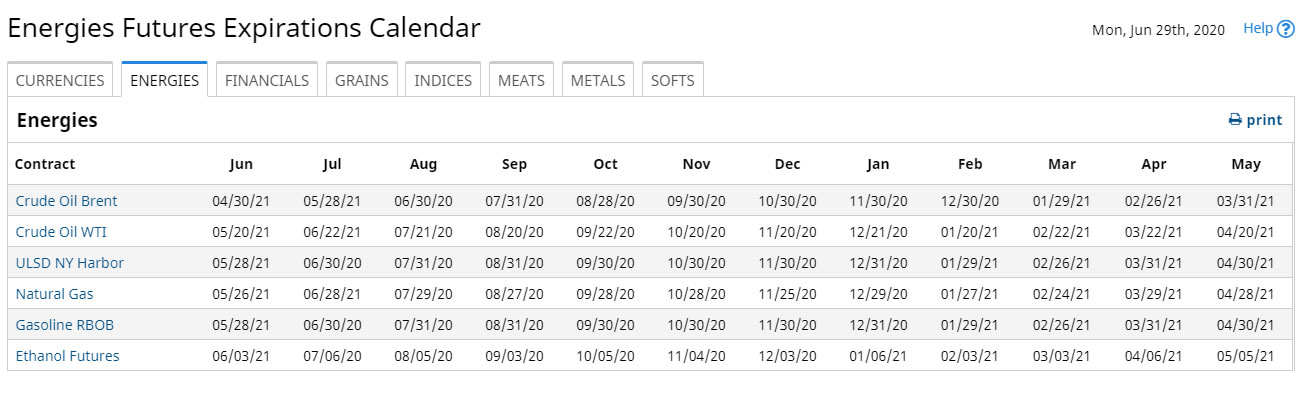
These periods can see heavy volumes as speculators close out futures and options contracts before expiry. Positions are then often re-opened in contracts that expire at a later date.
You can find a useful calendar for futures contract expiry dates on the BarChart.com website.
Please note, we are not responsible for third-party content
Fundamental Analysis
While technical analysis is useful when it comes to commodity trading, a lot of traders tend to focus on fundamental factors.
As we have already seen in a previous lesson, the basis for fundamental analysis is supply and demand.
Commodities trade in cycles. Sometimes supplies will be tight and prices high. Other times, there is too much of a commodity and prices fall as a result.
As a simplified model, the relationship between supply and demand can be illustrated by two general principles:
- If Demand > Supply = Higher Prices
- If Supply > Demand = Lower Prices
These principles help explain the general relationship between supply, demand and commodity prices. However, actual market movements are more complicated. Prices can also be influenced by expectations about future supply and demand, inventory levels, substitution between commodities, and the structure of futures markets. Consequently, changes in supply or demand do not always produce an immediate or predictable price movement.
Supply can be influenced by many factors, including weather, amount of acres planted, production strikes, crop diseases, and technological factors.
Demand is the amount that is consumed at a given price level. In general, demand will increase when the price of a commodity is low, and will decrease as the price of a commodity moves higher.
Data Releases
The relationship between demand and supply can be crucial for the price of a commodity, so it is important to monitor data releases.
For example, oil traders may look at the US Energy Information Administration (EIA) weekly change in oil inventories to see whether supply or demand is dictating the direction of the West Texas Intermediate (WTI) crude oil market. Rising inventories can indicate that supply is exceeding demand and may put downward pressure on prices. However, market reactions also depend on expectations, seasonal factors and the wider supply-and-demand outlook.

You can access these reports from the EIA website
Reports on Balance
While changes in inventories could indicate which side drives the market at the moment, reports on balance could confirm or negate those indications. They are published more rarely than reports on changes in inventories, but could carry more important information. For example, OPEC’s monthly report on the situation on the oil market is a type of report on balance.

It shows changes in demand, supply and production and includes forecasts for the future months.
You can download the latest OPEC report from the OPEC website
Many commodities have their own reports that you may want to monitor. The time around publication of these reports usually leads to an increase in volatility, so also be aware of when those reports are published.
Seasonality and Weather
Seasonality is an important part of the fundamental analysis of commodities. While currencies and indices tend to move randomly all over the year, the movement of certain commodities can see specific price moves at specific times of year.
Some commodities, such as corn and wheat, experience price movements due to annual growing cycles. For example, the markets are inclined to push prices lower during harvest time because supply is abundant and risk of weather interference in the yield has dissipated.
Conversely, grain prices are often pressed higher during the planting and growing seasons as speculators price in a weather-risk premium.
Other commodities such as crude oil, natural gas and precious metals don’t have predefined production cycles based on season, but the consumers of these products do.
For instance natural gas sees a rise in price in Autumn as energy providers begin stockpiling for the Winter.
Weather, can also play an important role in commodity markets. The colder it gets, the more expensive natural gas could become as demand surges.
Colder weather could be harmful to crops, which could send prices higher in wheat and other agricultural commodities.