

Central Bank Policy
In this lesson we will cover:
- Central Banks and their role in the financial system
- The most important Central Banks globally
- How Central Banks influence financial markets
- The two main policy positions of Central Bankers
Central Banks are the main bank of a country or region (for example, the European Central Bank is responsible for the whole of the eurozone).
Central Banks provide financial and banking services for their governments and the commercial banking system. They also issue currency and control the money supply – the amount of money in circulation.
The main objective of most Central Banks is price stability.
Central Banks are not commercial banks. Individuals cannot open an account at a Central Bank or ask them for a loan and, as public bodies, they are not motivated by profit.
The Importance of Central Banks
Central Banks are crucial not only for market participants, but also for the whole economy. They are responsible for price stability, and can also support economic growth or employment.
Central banks influence monetary conditions through measures such as interest-rate decisions and changes to the money supply. These monetary policy decisions can affect exchange rates, as well as other financial markets. Government fiscal policy, involving taxation and public spending, can also influence currency values.
One of the main tools of any Central Bank is setting interest rates – also known as the cost of money. As the Central Bank changes its rates, it influences not only the interest rates market, but also the Forex market, stock markets and potentially the price of gold and other commodities as well.
For example, if the Board of Governors of the Federal Reserve in the United States believe that the economy is performing well – the unemployment rate is low, economic growth is solid and inflation is on the rise – the Fed would likely act to raise interest rates to prevent prices from rising too much.
As rates go higher, loans become more expensive, so fewer individuals and companies are interested in taking them. This will slow growth and prevent the economy from “overheating”.
An overheated economy experiences a prolonged period of strong economic growth that leads to high levels of inflation (from increased consumer wealth). This causes a rise in prices and inefficient supply allocations as producers create excess production capacity in an attempt to capitalize on the high levels of wealth.
Unfortunately, these inefficiencies and inflation will eventually hinder the economy’s growth and can often be a precursor to a recession.
In regards to Forex, higher interest rates make loans and credit more expensive and deposits generate more interest. Global investors will consider purchasing the Dollar for a higher rate of return. This leads to higher demand for the US Dollar, causing it to rise in value.
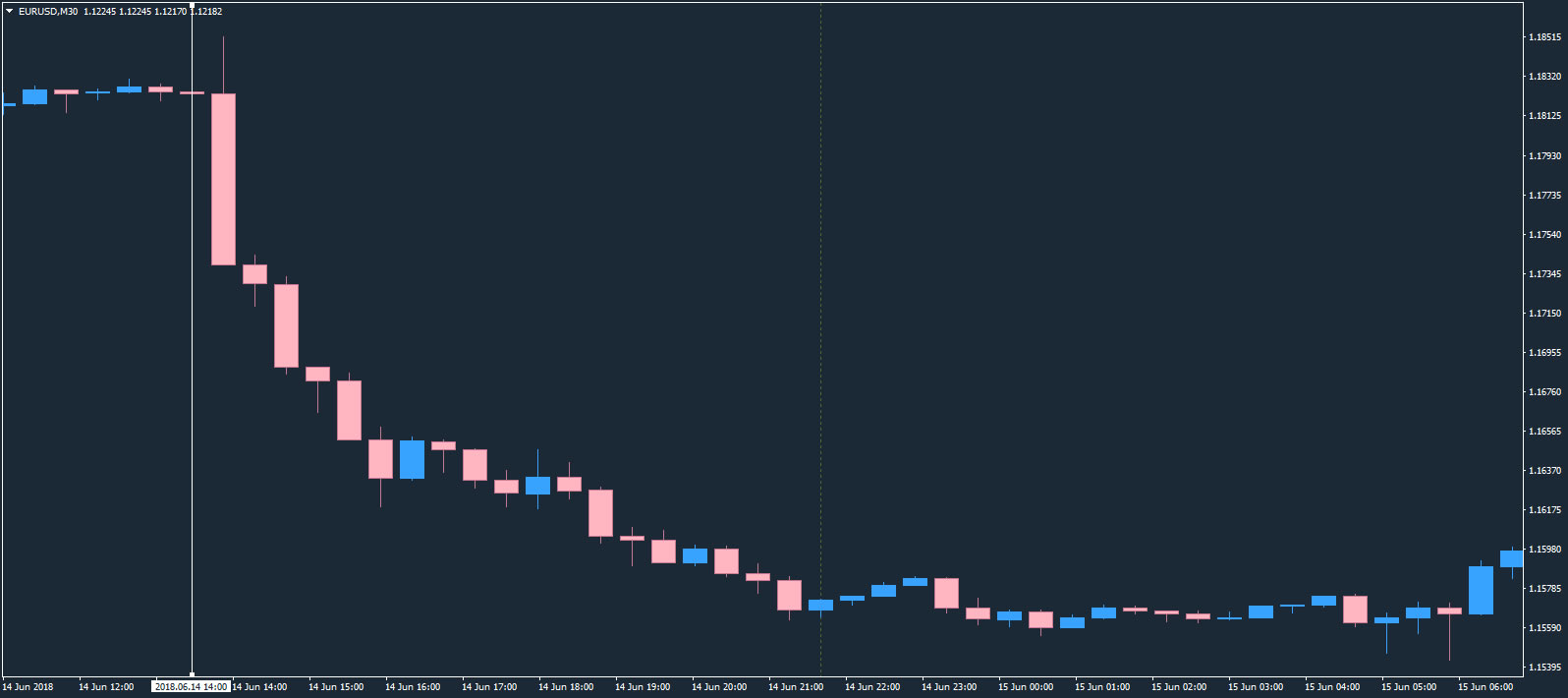
On 13th June 2018, the Fed voted to raise the target for its benchmark interest rate by 0.25%, citing solid economic expansion and job gains. As we can see from the chart below, the market reacted strongly, and the Euro fell more than 280 pips, a massive move for that pair in such a short space of time:
Interest rates are not the only tool that can be used by Central Banks. Central Banking has evolved and many extraordinary measures were introduced after the Great Financial Crisis (GFC) of 2008. Central Banks began buying government bonds and lending money to private financial institutions to encourage credit.
Following the 2008 Global Financial Crisis, central banks introduced extraordinary measures to stabilize financial markets and support economic recovery. These included emergency lending facilities, substantial reductions in interest rates and large-scale asset purchases, commonly known as quantitative easing.
The Federal Reserve’s policies helped improve financial conditions and are widely considered to have contributed to the subsequent recovery in US equity markets. However, the prolonged bull market that followed was influenced by several factors, including economic growth, corporate earnings and investor confidence.
Central Banks are the most important market participants. However, some institutions are more important and influential than others, as we will now examine.
The Major Central Banks
There are four major Central Banks in the world that have the most significant impact on financial markets. As you check regularly on upcoming news announcements, you will begin to notice the regular meetings held by these Central Banks, their announcements and the effects they have on the markets.
The Federal Reserve
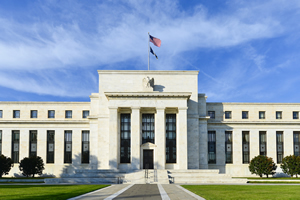
The Federal Reserve is the Central Bank of the United States. The Federal Open Market Committee (FOMC) is responsible for open market operations which are crucial for the financial markets.
The FOMC holds eight meetings per year. At these meetings, the Committee reviews economic and financial conditions, determines the appropriate monetary policy, and assesses risks to its goals of price stability and sustainable economic growth.
The FOMC meets twice a quarter, and the last meeting during each quarter is accompanied by a press conference where the Committee outlines its economic projections. The US Central Bank is run by the Federal Reserve Chair, and their speeches can have a profound impact on markets that are similar to interest rate decisions. Other members of the policy committee can also be influential on markets, because the FOMC’s decisions are based on a consensus that is developed by its members.
The European Central Bank

The European Central Bank (ECB) is the central bank of the 21 European Union countries that use the euro as their currency. The ECB is responsible for maintaining price stability in the euro area and preserving the purchasing power of the single currency.
The Governing Council is the ECB’s main decision-making body. It comprises the six members of the Executive Board and the governors of the national central banks of the 21 euro-area countries. The Governing Council meets to discuss the monetary policy every six weeks. Each meeting is followed by the Chair’s press conference.
The Bank of England
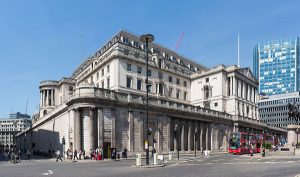
The Bank of England (BoE) is the Central Bank of the whole of the United Kingdom, not just England (although Scotland and Northern Ireland issue their own versions of Pound Sterling).
The Bank of England’s primary monetary policy objective is to maintain price stability, with an inflation target of 2%. Subject to this objective, it also supports the UK government’s economic policy, including its objectives for growth and employment. The Monetary Policy Committee adjusts interest rates and other monetary policy measures in response to changing economic conditions.
Monetary policy decisions are conducted by the Monetary Policy Committee that meets eight times a year. The head of the BoE is called the Governor, who participates in press conferences after only four of these meetings.
The Bank of England also publishes minutes from its meetings, along with any decisions it has made.
The Bank of Japan

The Bank Of Japan (BoJ) is the Central Bank of Japan. The BoJ’s main task is to maintain price stability, but it is important to note that since the 90s, the Japanese economy has been struggling.
For several decades, Japan experienced periods of weak economic growth, low inflation and deflation. In response, the Bank of Japan introduced unconventional monetary policy measures, including large-scale asset purchases, yield curve control and negative interest rates. In March 2024, the Bank of Japan ended its negative interest-rate policy and began moving towards a more conventional monetary policy framework, using short-term interest rates as its primary policy instrument. Its monetary policy continues to respond to developments in economic activity, inflation and financial conditions.
Bank of Japan members meet eight times a year to decide monetary policy.
Hawks & Doves
Different people have different opinions, so it’s not a big surprise that policymakers could have a different view on the economy as well as on monetary policy. Among Central Bankers, there are generally two groups – hawks and doves.
“Hawks” are policymakers that focus on keeping inflation low as their top priority. Hawks prefer higher interest rates and prudent monetary policy in order to keep inflation in check.
“Doves”, on the other hand, are policymakers that will tolerate higher inflation in order to boost economic growth and employment. Doves prefer lower interest rates.
If you read that a Central Bank is “hawkish”, they may be considering raising interest rates, or are bullish on the economy. For example, a hawkish Fed would suggest a possible interest rate hike, thus leading to a stronger dollar.
On the other hand, a Central Bank that is described as “dovish” may be looking to cut interest rates, which historically has a negative impact on currencies.
By paying close attention to these terms, you may find clues as to where the price of a currency might be moving to next.